
Take a look at: Administrative Divisions of Slavonia, to learn more about the Administrative Divisions of Slavonia over the centuries, . This will help you identify the county or administrative entity your family village is in, depending on the time period.
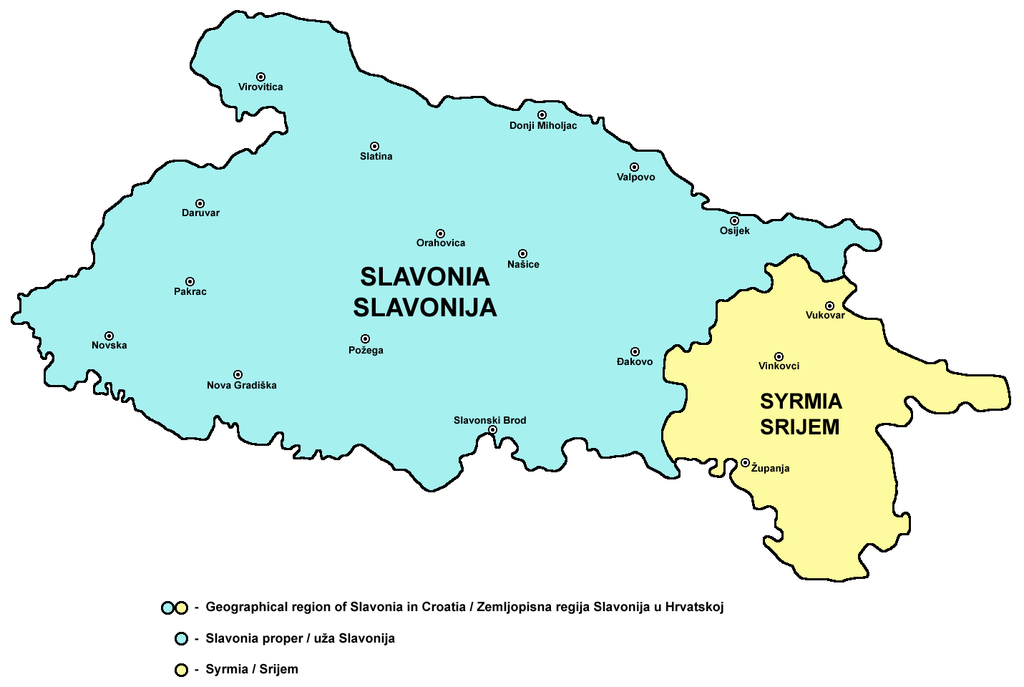
Slavonia (Croatian: Slavonija; German: Slawonien) is a geographical and historical region in eastern Croatia. It is a fertile agricultural and forested lowland bordered by the Drava river in the north, the Sava river in the south, the Illova river in the west and the Danube river in the east, with Syrmia.
While generally known as a lowland, Slavonia does actually have a number of hills. The main ones are Psunj, Papuk, Požeška Gora, Ravna gora, Krndija and Dilj, which in turn encircle the valley of Požega.
In the early medieval period of the Kingdom of Hungary, Slavonia was a dependent province of the Kingdom, and included only the western part of present-day Slavonia, but also parts of present-day central Croatia (including Zagreb) and the western and northern parts of present-day Bosnia (The eastern parts of present-day Slavonia belonged to Hungary proper). In the late Medieval period Slavonia occupied territories between the rivers Sava, Drava, Sutla and Danube. In the 18th and 19th century, the Kingdom of Slavonia was a province of the Habsburg Monarchy, and included northern parts of present day regions of Slavonia and Syrmia, while the southern parts of these regions were part of the Habsburg Military Frontier (Slavonian Krajina).
For more specific information about individual villages, check the Villages Index
Die Deutschen in Syrmien, Slavonien, Kroatien und Bosnien
By Dr. Valentin Oberkersch
Translated by Henry A. Fischer with Oberkersch family permission
Compared to the emerging settlements in Syrmia, very little development took place in Slavonia. Germans who came from Tolna County Hungary settled Johannesdorf (Jovanovac) in 1836. In 1843 Germans from Veszprem County in Hungary settled Neu Zoljani.
To a large extent Slavonia remained a wilderness. The Swabian villages of Hungary and the Batschka were overcrowded. The government in Vienna Austria set the stage for a new settlement movement.
The Regulation and Decree was issued by the Emperor on December 31 1858 and was addressed to Hungary, Croatia, Slavonia, the Serbian Vojvodina, the Banat, and Transylvania with a renewed call for agricultural settlement and development. Some of the regulations included: homes for 50 families or more, all members of the community must be of one nationality regardless of origin, and of one religion.
The results of the new settlement decree was not very successful in Croatia and Slavonia. Only 10 German settlements were established in response to it. Three were established in 1866. They were Blagorodovac, Eichendorf-Hrastovac, and Antunovac. The settlers came from Baranya, Tolna, and Somogy Counties in Hungary. In the same year there were settlements established in Sokolovac, Miokovicevo, and Dobrovac. Filipovac was settled in 1886. The village of Kerndia was settled in 1880/1881. The last two communities were Kapetanovo Polje in 1882 and Franjevac- Strizicevac in 1886. The land involved was heavily forested wilderness and the main task of the colonist was clearing the land.
Syrmia Coordinators:
Volunteer as a Coordinator
Contribute content
Last updated: 08/26/2026